

hyperAphantasia
On a gap in the vocabulary, and a word for what fills it

I.
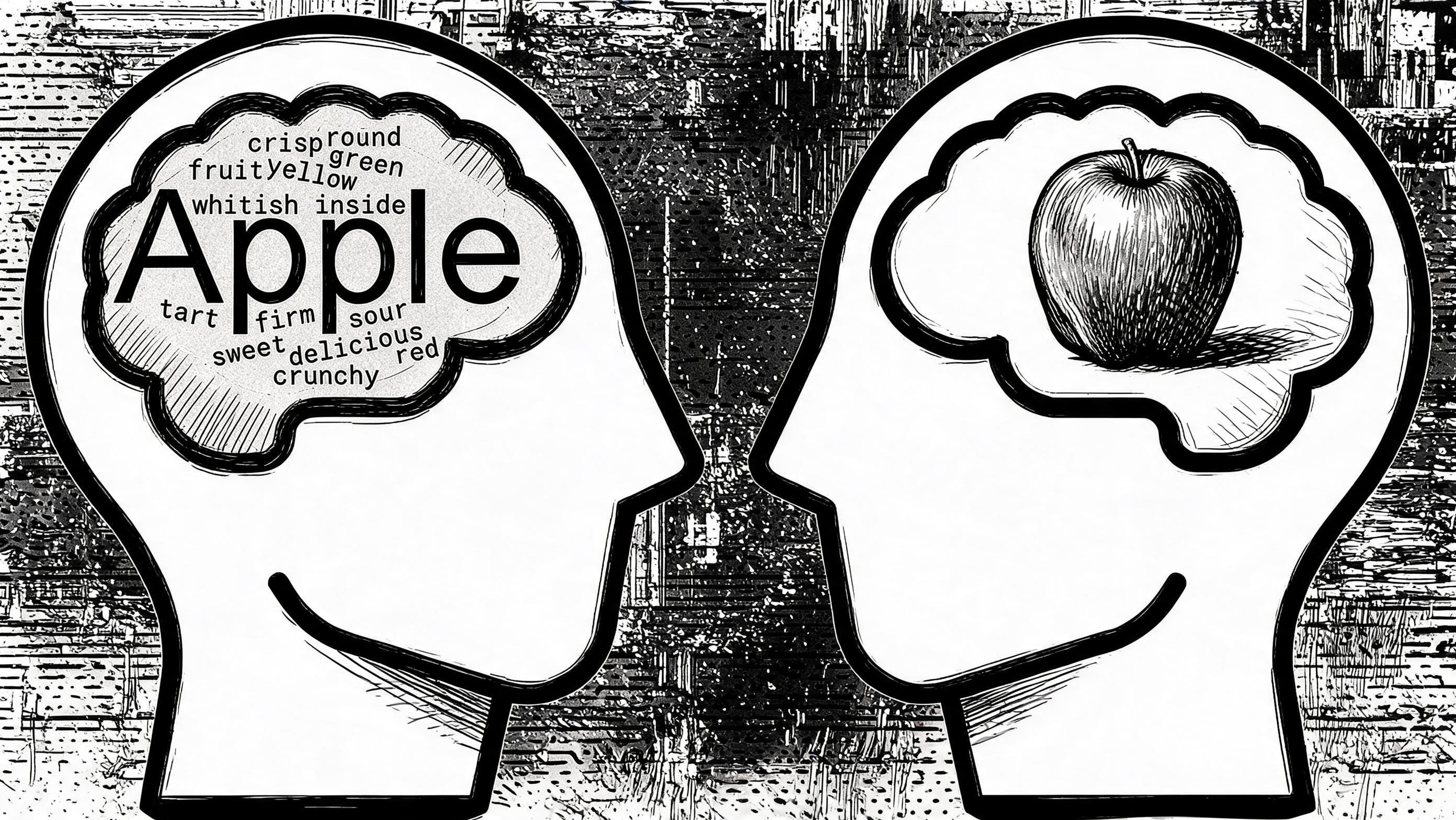
Ask someone to picture an apple. Most people report that something happens -- not immediately, but within a fraction of a second, a rough or vivid image assembles in the mind. Some report something barely there, a vague impression of redness and roundness. Some report something bright and photographic. The instruction lands, and a visual representation, however faint, appears.
For a small percentage of the population, nothing appears. The instruction is received and processed -- the word apple arrives, the concept is accessed, the object is known -- but the visual channel does not engage. No picture assembles. The screen, as a working metaphor, is dark. What does have a name in the literature is that darkness. What does not yet have a name is what may be running on the other side of it -- and the first indication that something was running came not from the literature but from a film.
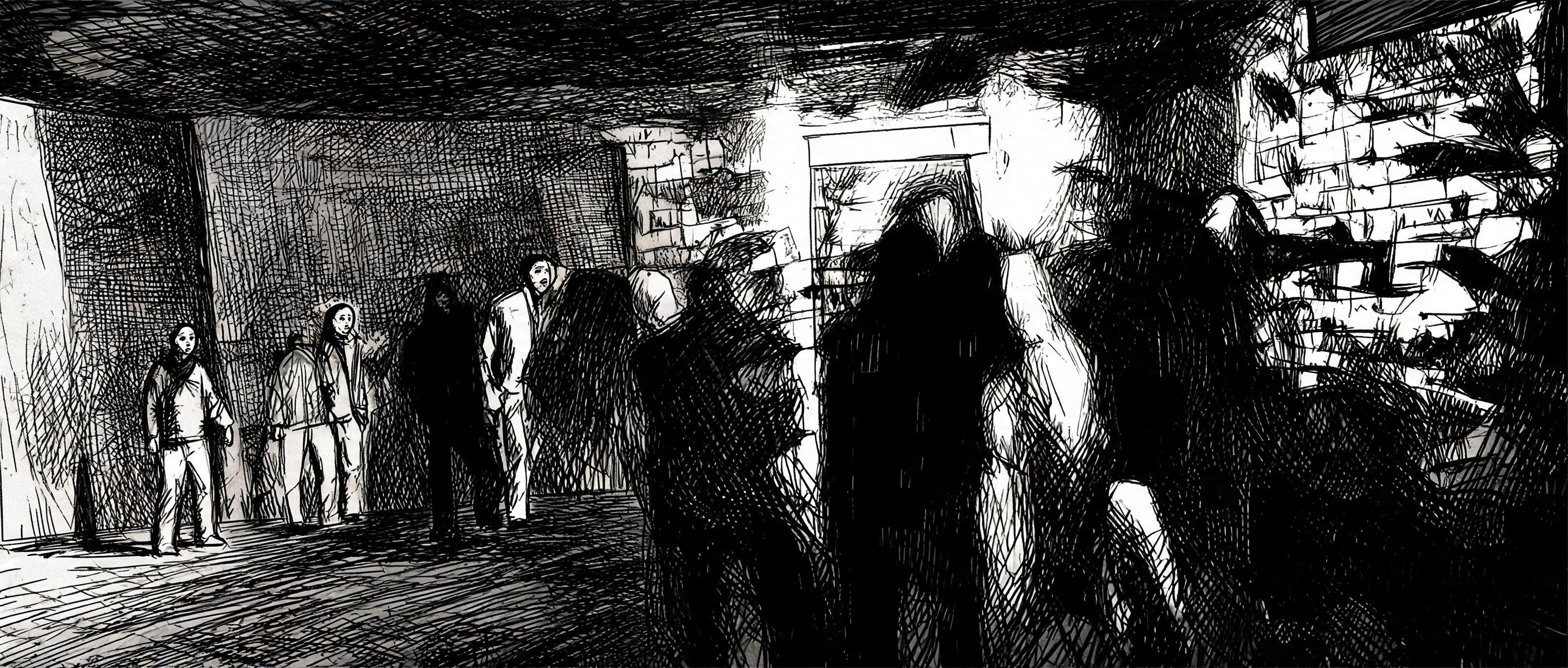
The bar scene in A Beautiful Mind shows John Nash solving a game-theory problem in a crowded room: the social field resolves into a legible structure of competing interests and probable outcomes, and Nash operates on it as if it were an object he could hold. The depiction was useful not because the film explained anything but because, to anyone running this architecture, it read as documentation rather than invention. The recognition was immediate. The vocabulary for what was being recognized was not.
That recognition began a search. The film had named one property of the cognition; it had not named all of them. What followed was a cataloging of available media for better and more complete external referents -- each one found because the previous one was insufficient. The taxonomy arrived later, after the search had already established that the existing vocabulary had nowhere to put what the search was looking for.
The vocabulary that describes how minds produce internal imagery is built around a single axis: the presence, the absence, and the gradations between -- of voluntary mental pictures. The extremes have been named -- aphantasia at one end, hyperphantasia at the other1. A separate axis -- prophantasia -- distinguishes the capacity to project imagery externally onto surfaces or into the visual field from the interior mind’s-eye spectrum; its existence as a distinct dimension suggests that the vocabulary for mental imagery has not yet settled its own axes, let alone its far edges.
What this taxonomy measures, in all its current forms, is the presence or absence of visual mental imagery. What it does not measure is the underlying substrate -- the medium through which cognitive processing runs, not the output the mind produces but the material through which it produces that output. The taxonomy is, in this sense, substrate-blind. It assumes a single architecture varying along a single axis of intensity. That assumption is the gap.
II.
The substrate question was the central claim of It’s All Greek to Me2, a prior essay in this publication. The argument there: cognitive processing is not a single substance running at different volumes across the species. It runs on different operating systems. A visual-and-emotional encoding system, dominant by demographic share. A mathematical-and-spatial encoding system, present in a smaller population. A language-encoding system, smaller still. Each is a different implementation of the same underlying function. Each produces serviceable output. The output may look indistinguishable from the outside while the machinery producing it is alien across the gap.
That visual-and-emotional encoding is the demographic default is a fact about distribution, not architecture. The two are routinely collapsed -- and the imagery vocabulary inherits the collapse. A taxonomy built around the outputs of the dominant encoding system will fail to detect what is happening at the far edges of any other.
One clarification before proceeding, because the architecture described in what follows is easily misread. When the language-encoding system is named here as the relevant substrate, the output being described is not primarily linguistic. The language-encoding system does not produce text. It produces relational structure -- environments, spatial layouts, predictive fields, manipulable architectures built from the relational logic that language, at its base, is. The distinction between the language-encoding substrate and the mathematical-and-spatial encoding system is not that one is verbal and the other is spatial. It is that one constructs through relational logic and the other constructs through formal structure. The outputs can overlap. The mechanisms differ.
hyperAphantasia names the capability that emerges at the far edge of the language-encoding architecture -- a capability the visual-output taxonomy is structurally incapable of registering, because it is measuring the wrong variable.
III.
What the bar scene had started, the search continued. A Beautiful Mind had documented one property -- the social field resolving into a navigable structure -- but the cognition has several properties, and no single referent was adequate to all of them. Four additional referents were found; each one isolated something the previous could not. The referents are drawn from fiction because the experience has no documentary record outside it -- there is no real-world archive of what this architecture looks like from the inside, only borrowed images from systems that approximate one property at a time.
The first addition addressed real-time spatial-predictive overlay -- what the bar scene had not captured. The Terminator’s heads-up display and the routes overlaid on a football field in Madden play-calling approximate what happens during driving, crowd navigation, or any high-speed spatial task: the world arrives pre-annotated with trajectories, gaps, and behavioral projections. The annotation is not seen. The cognition operates on it as if it were already threaded through the physical fact of the environment.
Even that addition had not isolated the property of full spatial geometry without any visual content whatsoever. Daredevil’s echolocation provided it: every dimensional detail required to navigate an environment -- distance, geometry, the trajectory of a moving body -- present and accurate, without a picture. The phrase perception without picture may be the most compact formulation available for what this describes.
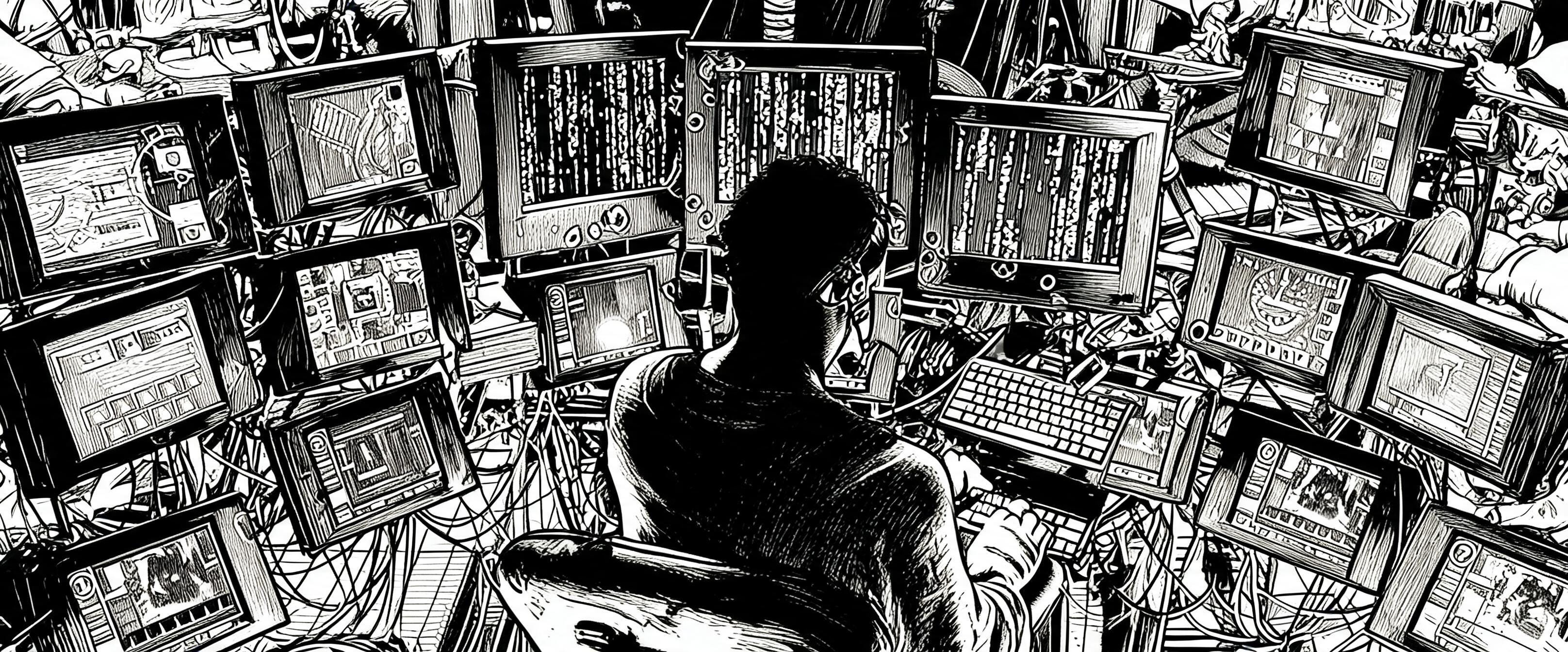
Neither of those had captured what it is to read the system rather than see the output. The Matrix operator does: watching cascading code and extracting from it everything needed to navigate the world the code represents. The operator is not seeing the world. The operator is reading the system that produces the world. For this architecture, the code is not a substitute for the image. The code is the native medium.
The last referent the search reached was the architecture of complex problem-holding. Tony Stark's holographic table comes closest: a structure that can be rotated, zoomed into, pulled apart, and recombined in real time, with gaps sensed before the missing piece is named. A thread pulled from it leads somewhere before the destination can be stated. It is what it is to work inside a representation that is not a picture.
What all of these borrowed images share is the property the person with this architecture is trying to convey: invisible in blackness, but as real or more real than the visual images used to describe it. There is no picture. There is no shortage of structure‽ The two facts coexist without contradiction because they have never actually been in conflict -- only the vocabulary assumed they must be.
What this architecture also produces, less obviously: a memory system organized around language and relational structure rather than around visual scenes. The past does not return as an image. It returns as an exact relational-linguistic event -- who said the word, how it was defined, the structure of the argument, the relative positions of speakers in a room -- without a picture of any of it. The phenomenon was once described, in a working note, as photographic memory containing no photographs. The phrase is more precise than it first appears: what is stored is not a degraded or incomplete version of the visual memory a sighted thinker keeps. It is a different object entirely -- encoded in a different medium, with its own fidelity and its own failure modes.
A related dynamic, explored at greater length in What the Sound Already Knew3, concerns how unfamiliar words arrive at this architecture. When a new word enters the system, an image is not generated of what it refers to. The word is processed through its own material -- root, affix, sonic register, etymological pressure, conceptual neighborhood -- and something usable is assembled from the structural traces. The result is not a picture. It is an environment built from the word’s own scaffolding, navigable as if it were a place.
IV.
The term being proposed is hyperAphantasia. The lowercase h and the capitalized A are not stylistic. They are an orthographic claim, and it needs to be stated directly, because the term carries a naming risk.
Some popular sources already use the spelling “hyperaphantasia” -- lowercase throughout -- to refer to hyperphantasia: the condition of unusually vivid mental imagery at the opposite end of the spectrum from aphantasia. A reader who encounters that usage first may arrive at hyperAphantasia assuming it means the same thing, or treating the capital A as a typographical variant. It is not. The capital A is doing definitional work: it signals that Aphantasia remains the root identity, that the hyper- prefix does not move the term toward the opposite pole but marks a specific configuration within the aphantasic category. I have not encountered the term used in this specific framing -- lowercase h, capital A, naming a variant within rather than a position opposite -- in any existing literature or usage. The slot is empty. The orthography is the argument.
With that distinguished: the prefix hyper- is not functioning as an intensifier. This is not “extreme aphantasia,” and the term is not a synonym for the most severe presentation of the condition. It marks a variant within the aphantasia category -- not a more extreme point along the same axis, but a different configuration within it.
What distinguishes the variant is what runs in the absence of the visual layer. In many popular accounts of aphantasia, and in the experience of many people who carry the diagnosis, the absence of visual imagery is described alongside a broader reduction in internal representation -- spatial navigation more difficult, architectural imagination diminished, the structural channel quieter alongside the visual one. The research literature notes genuine heterogeneity here, including documented cases of preserved spatial reasoning within aphantasic populations; the standard popular description is not universal. But the expectation of broader representational poverty is common enough to function as a default -- and hyperAphantasia is specifically built to name that expectation as a false one for this variant.
In hyperAphantasia, the structural channel is not off. It is operating at a capability that, by the logic of the visual-output taxonomy, should not be available in the absence of imagery -- and yet is. The processing architecture generating it is not the visual system in reduced form. It is the language-encoding system running at a register the taxonomy does not measure.
This distinction is load-bearing, and it is easy to get wrong. The framing to avoid is compensation -- as if the language system has stepped in to fill the void left by the visual system’s failure. That framing concedes the wrong premise: that visual cognition is the architectural default and any other encoding system is a backup. The correct framing is implementation. These are different implementations of the same underlying function -- producing, holding, and manipulating internal representations of a world. hyperAphantasia is what the language-encoding implementation produces at the far edge of its capability. It is not a workaround. It is what the system does when it is running well.
A new term is necessary because the existing vocabulary cannot register the distinction. Calling this implementation “aphantasia” undercounts the capability. Calling it “hyperphantasia” misidentifies the encoding system -- there is no excess of visual imagery here; there is no visual imagery at all. The taxonomy has nowhere to put what this essay is trying to name. hyperAphantasia is built to occupy the slot the taxonomy could not see.
V.
A note on the population, offered as orientation rather than as a peer-reviewed claim.
Aphantasia appears in something on the order of one to three percent of the population per the current literature -- a figure still under active revision. hyperAphantasia, as defined here, would constitute a subset of that subset: a small fraction of an already small number. No reliable prevalence figure exists, because no reliable definition has previously existed. What can be said, from a small number of conversations the author has had with other aphantasic interlocutors, is that most did not recognize the architecture described here as their own. Their aphantasia presented closer to the common description -- the visual channel closed, and the structural channel diminished alongside it. The recognition, when it occurred, was infrequent enough to suggest that the variant being named is rare enough not to have been mapped yet.
Why the term does not yet exist in the literature follows from that rarity. The aphantasia research community has, only in the last decade, established aphantasia itself as a legitimate cognitive variation rather than a quirk of introspection. The internal structure of that category -- its sub-variants, its architecture-level differences, the asymmetries between aphantasic populations -- has not yet been systematically mapped. The vocabulary lags the phenomenon. This is ordinary. New categories are discovered as bulk objects and only later resolved into their constituents.
What this essay proposes is a term for one of those constituents. Not a discovery. A first transmission of a word for something that has been operating, unnamed, in a small population for as long as the species has had language as a processing medium. The architecture has not been waiting. The word has.
-- -- --
Aphantasia describes the channel that is closed. hyperAphantasia describes the architecture that may be running instead.
The screen is dark. The machine is not.
Zeman, A. Z. J., Dewar, M., & Della Sala, S. (2015). Lives without imagery -- congenital aphantasia. Cortex, 73, 378--380. Prevalence estimates for aphantasia vary considerably across studies; current figures range from under one percent to approximately three percent of the general population and remain under active revision as the field develops more consistent methodology for self-report screening.

On a personal note - thank you for opening my eyes to this. Understanding how my software operates has given me a profund new clarity about myself.😉 The screen might be dark but the focus between our system is officially perfect ☺️
Yes, exactly this! This is what I keep trying to explain when I write about aphantasia: that the lack of mental pictures does not mean the inner world is empty. It doesn’t mean we aren’t imagining, remembering, sensing, understanding, or building meaning. It just means the architecture is different.
I love the way you framed this as “the screen is dark, but the machine is not,” because that feels so precise. There is so much happening beneath the visual layer, language, pattern, structure, knowing, memory, intuition, sensation, and so often aphantasia gets flattened into “can’t see pictures,” as if that tells the whole story. It doesn’t. Really well done.